
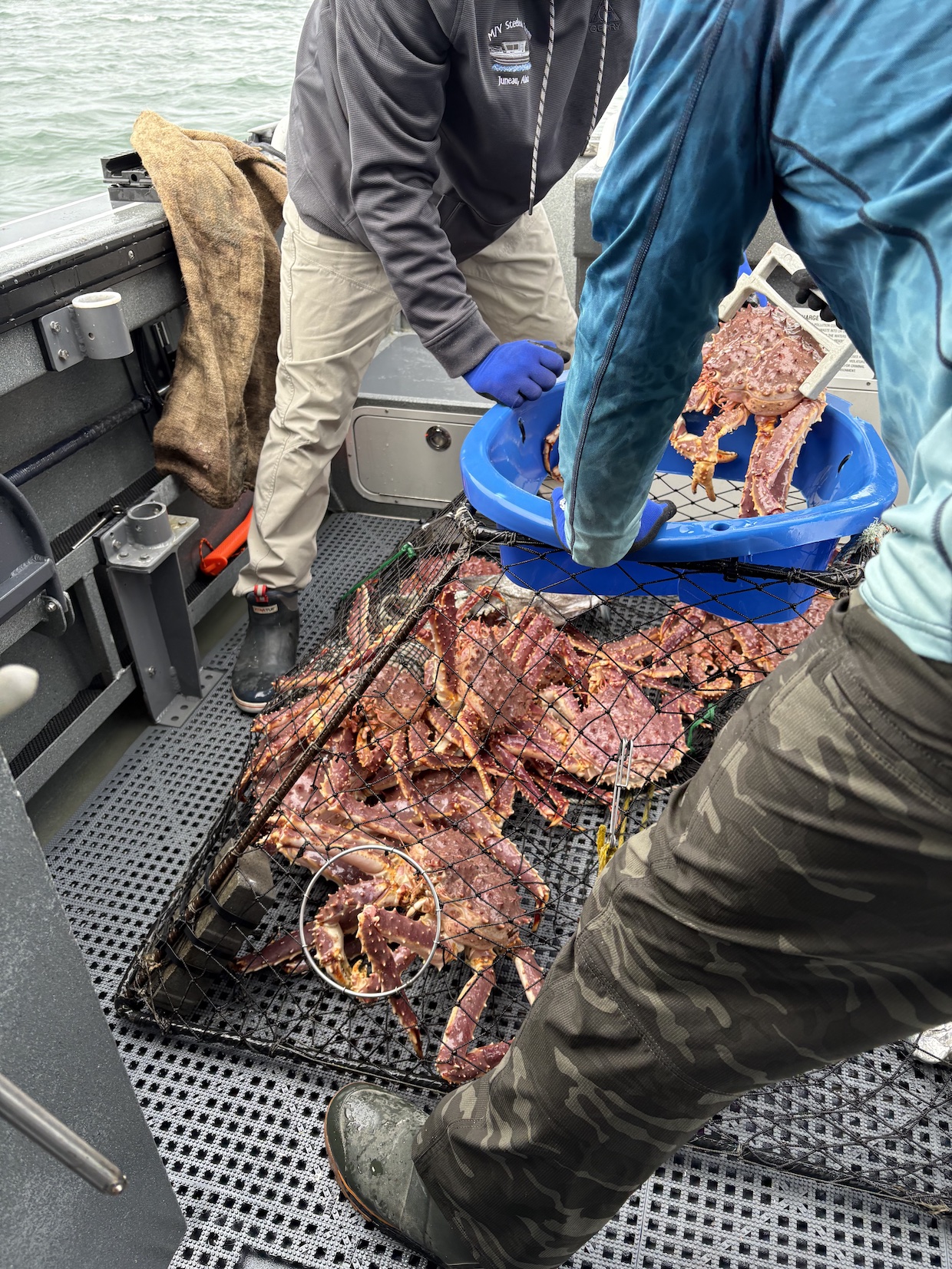
I love the anticipation of hauling in a king crab pot.
As the boat’s winch lifts the heavy trap from the depths, our minds replay all the variables that affect the catch: Did we use the right bait? Did we drop the pot onto a level spot? Are we even in an area where the crabs are?
And then – the rush of exultation as the pot breaks the surface and we see a huge tangle of legs and claws clinging to the side of the net, the bait ball, and each other.
Yes! My mouth is already watering.
But we can’t start melting the butter just yet. We’ve got to sort the pile before we can feast.
The thought occurs to me that family conflict can feel like a pile of crabs to be sorted. It’s a tangle of individuals clinging to (or fighting over) misconceptions, hurt feelings, misaligned expectations, and sometimes even actual instances of ill intent or mistreatment.
We often avoid sorting through family conflicts because there are too many variables affecting the problem. But, like crabs left in a trap too long, conflicts that aren’t brought to the surface can cannibalize a family’s relationships.
If we want a feast of peace within our family, it’s worth the work to sort through conflicts sooner rather than later.
But how do we start? Fortunately, there’s a simple decision tree for sorting crabs that lends itself to triaging family conflicts.
The First Sort: Is This Conflict Even Yours to Untangle?
Not every crab goes in the bucket. Asking “Which ones are keepers?” is a quick way to start sorting the catch. For Alaskan king crab, only males can be harvested, so we automatically toss the females back.
Well-meaning family members (or sometimes straight-up busybodies) often complicate family conflict by adding to the tension with extraneous advice, support, or, most unhelpfully, judgment.
“Who needs to sort this out?” is a practical question that limits the conflict to the principle players. While we don’t literally toss peripheral people overboard, asking them to step back removes distracting voices and allows us to focus on getting to the root of the issue.
The Second Sort: Is This One Real Conflict or a Pile of Smaller Irritations?
In addition to being male, keepers must be at least seven inches across the widest part of the shell. If they don’t measure up, they go overboard for us to catch another year.
It’s very tempting to eyeball this, but for integrity’s sake we measure. So many times a crab that “looks big enough” measures just short of legal. A rigid 7-inch gauge laid across the crab shell keeps us honest.
We need a similar gauge for evaluating family conflict. Sometimes what feels like one big fight is actually several smaller, separate irritations that only look large because they’re stacked in the same bucket. Asking “What problem is still big when the small stuff is pulled away?” is a helpful way to discern the real conflict.
The First Task: Separate the Issue into Smaller Parts
Removing a tangle of crabs from the trap requires patience and a methodical approach. If we just reach in and start yanking them apart, we risk being pinched by the claws, getting cut by the spines covering the shell, or accidentally dismembering a crab we can’t keep.
The best practice is to carefully take hold of the shell and free one leg at a time until the whole crab is loose.
Teasing apart family conflict takes similar careful handling to protect all the people and relationships involved from lasting hurt or estrangement. Just as different legs belong to different crabs, family conflict often separates into different issues for different people. Knowing who is upset about what provides clarity for understanding and resolving the problems at the heart of the conflict.
The Second Task: Decide What is Worth Working On
If we are lucky enough to catch more than our legal limit, we must decide which ones to keep. That decision is a no-brainer for crabbing; we keep the biggest ones. If we are going to put in the work to process them, we want the biggest pile of crabmeat as our reward.
And there is considerable work to be done. Cleaning and cooking are fairly quick, but cracking a steaming pile of crab legs is tedious, time consuming, and messy.
Resolving family conflicts can be equally laborious. If we’ve done a good job of naming and sorting the issues, we can see where we have the greatest potential for healing and restoring relationships. Those are the problems worth working on.
Getting Started
So how do we do the actual work of resolving family strife? Our family has cracked enough crab together to offer some insight.
First, everyone chooses a leg. We put the whole tub of steaming crab in the middle of the table, so each person can survey the pile and decide which one to take. Eventually we will work our way through the whole catch, trading advice, sharing tools, and offering assistance, but at the outset everyone starts with their own task.
In family conflict, this translates to ownership and collaboration. Lay out the issues and let everyone choose something to work on. Some problems will be solved by individual effort, and others will need a team approach, but everyone must commit to taking part.
Second, use the right tools. Sharp, heavy-duty scissors cut through the crab’s legs easily, but the thick claws require a mallet to crack open. Knuckles and joints need only slender seafood picks to extract the meat.
We can work on family conflict more efficiently by using the right combination of resources, too. This includes recognizing the skills and strengths each person brings to the process. Who has wisdom, who thinks outside the box, who isn’t afraid of hard conversations, who is tactful? Use each person where they can help most effectively. A complex conflict might even require seeking professional counseling or mediation.
Getting it Done
Leaving the crab in the center of the table allows us to monitor our progress. It’s so satisfying to watch the pile dwindle as the bowl of crabmeat fills and the empty shells are discarded. But it does take time. And yes, we all pause at some point to snitch a bite or two. Then we get back to work, knowing the real feast will happen once we are done.
Family conflicts will never be solved as quickly as processing a catch of seafood together. It might take a long time for people to come to the table, or we’ll get frustrated over how others handle their tasks. But celebrate the progress, even if it only happens a leg at a time.
Keep the tub in the middle of the table, and keep working on it. The feast is worth the work.
Comments
One response to “Finding the Keepers: A Framework for Sorting Through Family Conflict”
Finally had a moment to read this! So interesting. I love the crab/conflict comparisons.